
What do Luke Skywalker, Harry Potter, and an expat have in common?
More than you might think at first glance: they all leave their familiar world behind, face unknown challenges – and grow as a result. The structure behind such transformation processes is one of the oldest narrative forms known to mankind: the hero’s journey.
Many great stories – whether in ancient myths, modern novels or Hollywood films – follow this pattern. The hero’s journey describes in twelve stages the path of an ordinary person who sets out to enter a new world and overcome challenges. They embark on an adventure and return as a victorious hero.
Similar to movie heroes, expats also set out on a journey – into a new environment, a new system, a different culture. They too experience moments of doubt, change, and learning – and in the process they develop new skills, perspectives, and often a new sense of self.
The hero’s journey is therefore not just a cinematic concept. It is an excellent way of understanding such development processes – and providing practical support. Those who examine its structure can better assess their own situation and understand inner processes: Am I still in familiar territory? Am I about to take the leap? What kind of support do I need right now?
In the upcoming articles in this series, we will take a closer look at the twelve stages of the hero’s journey and show how this structure can be applied to life and work abroad. The story of Luke Skywalker in Star Wars: Episode IV serves as our cinematic example. Not because every assignment is like a galactic adventure, but because it impressively demonstrates that change is possible.
The hero’s journey reminds us that no one starts out as a hero or heroine. It is the journey itself – with its challenges, insights, and supporters – that allows us to grow. And so every assignment, every departure into a new world, can also become a journey of personal development.
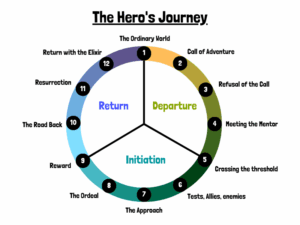
12 Hero’s Journey Stages Explained (Free Templates) | Imagine Forest