
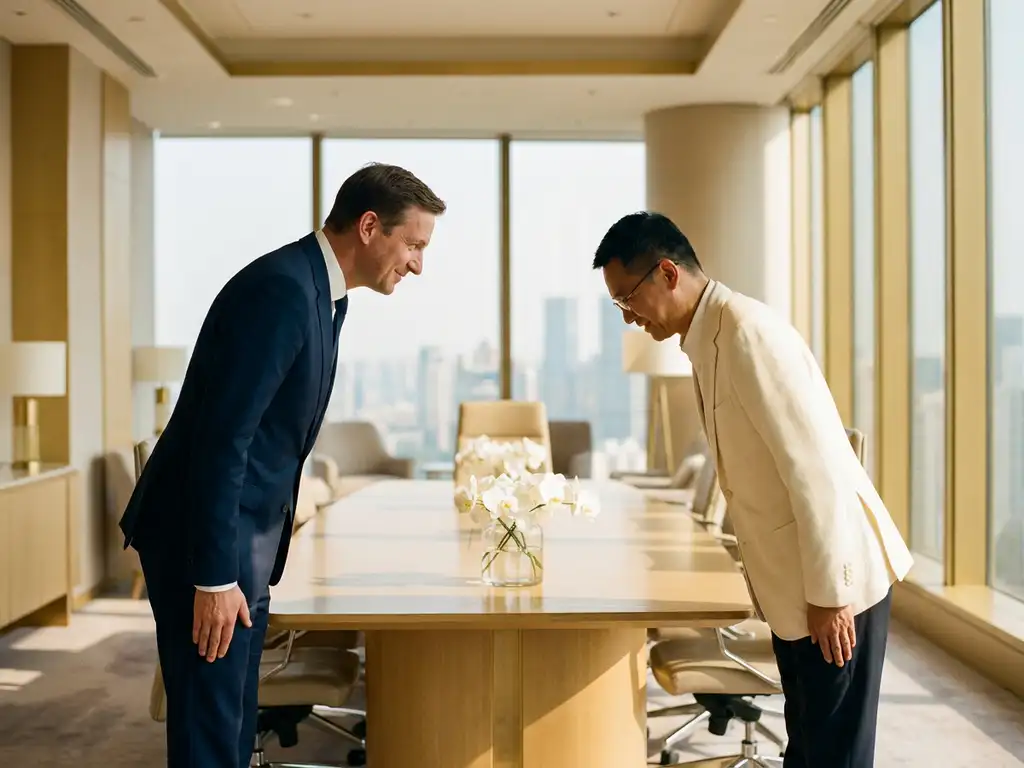
To greet a Chinese businessman, extend a light handshake, nod slightly, and address him by his title and surname. Chinese business etiquette places a strong emphasis on respect, hierarchy, and first impressions, so getting the greeting right sets the tone for the entire relationship. Below, we answer the most common questions about greeting customs in Chinese business culture.
What is the proper way to bow or shake hands in China?
In Chinese business settings, a light handshake is the standard greeting, often accompanied by a slight nod or a small bow of the head. Unlike Japan or Korea, full bowing is not a deeply ingrained practice in Chinese business culture. A firm Western-style handshake can feel aggressive, so keep your grip moderate and let your Chinese counterpart set the pace.
If you are meeting a group, greet the most senior person first. This signals awareness of hierarchy and immediately earns you respect. Eye contact during the handshake is fine, but avoid prolonged direct staring, which can feel confrontational in some contexts. A warm smile goes a long way in breaking the ice.
Physical contact beyond a handshake, such as a pat on the back or a hug, is generally not appropriate in a first business meeting. Keep your greeting measured and composed. This restraint reads as professionalism, not coldness.
How important is hierarchy when greeting Chinese business partners?
Hierarchy is extremely important in Chinese business etiquette. Greet the most senior person in the room first, always. Skipping this step or greeting people randomly signals a lack of cultural awareness and can create an uncomfortable atmosphere before the meeting has even started.
Seniority in China is often tied to age, title, and organizational rank. If you are unsure who the most senior person is, pay attention to where people are seated, who enters the room first, or who others seem to defer to. These are reliable cues.
Addressing people by their professional title, such as Director Wang or Manager Li, reinforces the respect that hierarchy demands. Using first names too quickly, as is common in many Western cultures, can come across as presumptuous or overly casual. Save that informality for once a genuine relationship has developed over time.
What should you say when greeting a Chinese businessman?
A simple “Nǐ hǎo” (hello) or “Nín hǎo” (the more formal version) is always appreciated and signals that you have made an effort. In a business context, following up with the person’s title and surname, for example “Director Chen, it is a pleasure to meet you,” is the right approach. Complimenting the company or expressing genuine interest in the collaboration also starts things off well.
If you do not speak Mandarin, do not worry. Most Chinese business professionals working in international contexts have some English. What matters more than language is tone: speak clearly, avoid slang or idioms that do not translate well, and project warmth and respect.
Small talk before diving into business is common and expected. Topics like the journey to China, the city you are visiting, or general observations about the country are safe openers. Avoid politically sensitive subjects entirely, especially in an initial meeting.
How do you exchange business cards with a Chinese contact?
Business card exchange in China is a formal ritual that deserves careful attention. Present and receive cards with both hands, take a moment to read the card before putting it away, and never write on it or shove it into a back pocket. These small gestures communicate respect for the person and their role.
If you have cards printed in both English and simplified Chinese, bring them. Presenting a bilingual card shows preparation and respect. Place received cards on the table in front of you during the meeting, arranged in the order people are seated if possible. This shows you are paying attention to who is who.
Treating a business card carelessly is one of the most common and avoidable mistakes Western professionals make. Think of the card as a small representation of the person, and treat it accordingly. Our China intercultural training covers this ritual in detail alongside many other practical business customs.
What common greeting mistakes do Western businesspeople make in China?
The most frequent greeting mistakes Western businesspeople make in China include using first names too quickly, gripping too firmly in a handshake, ignoring the seniority order when greeting a group, and mishandling business cards. Each of these signals a lack of cultural preparation and can quietly undermine trust from the very first moment.
Another common error is projecting Western directness too early. In China, relationships are built before business is discussed openly. Jumping straight into deal-making without investing time in the greeting and small talk phase can feel transactional and off-putting.
Loud or overly expressive greetings, the kind that might feel enthusiastic and friendly in the US or Germany, can come across as overwhelming in a Chinese business context. Composure and measured warmth are the right register. Think of the greeting as the first step in building a relationship, not just a formality to get through.
Do Chinese business greeting customs differ by city or industry?
Yes, Chinese business greeting customs do vary somewhat by city and industry. Professionals in Shanghai and Beijing, particularly those who work in international finance, tech, or consulting, are often more accustomed to Western styles of greeting and may even initiate a more casual tone. In smaller cities or more traditional industries, formal customs tend to be observed more strictly.
Younger Chinese professionals, especially those educated abroad, may feel comfortable with a more relaxed approach. However, defaulting to the formal standard is always the safer choice until you have a clearer read on the individual and the context.
Industry also plays a role. State-owned enterprises and government-adjacent organizations tend to maintain stricter protocols around hierarchy and formality. Private tech startups or creative agencies may have a more relaxed atmosphere. Doing a bit of research about the specific company and sector before your meeting helps you calibrate appropriately.
How crossculture academy helps you prepare for Chinese business meetings
Getting Chinese business etiquette right goes well beyond memorizing a few rules. It takes real cultural understanding, and that is exactly what we help you build at crossculture academy. Whether you are preparing for your first trip to China, relocating there, or managing a team across borders, we offer practical, targeted preparation that makes a real difference.
- Country-specific China business training covering greetings, hierarchy, communication styles, and relationship building
- Flexible E-Learning courses you can complete at your own pace, wherever you are
- Short video modules for quick, focused learning on specific topics like business card etiquette or meeting protocols
- Expert coaching for individuals and teams, drawing on the experience of more than 450 international trainers and consultants
- A 24/7 expert hotline for intercultural business questions that come up in real time
If you are heading to China for business and want to walk into that first meeting with confidence, get in touch with us and we will help you find the right preparation format for your needs.